Political realignment after Luparello’s death
The Shape of WaterPolitical realignment after Luparello’s death is the rapid transfer and renegotiation of authority within his party after Silvio Luparello’s death. The public succession appeared to install a rival as a new leader, but Pietro Rizzo’s unexpected role alongside him, and the displacement of most of Luparello’s political followers, made the change look less like a clean break than a contest over who would inherit the network behind the party’s formal offices.
The Network Before the Succession
Luparello’s political position had been built over many years, first through social ties and then through the practical control those ties could support. An heir to a Montelusa building dynasty, he returned to his hometown after graduating with highest honours from Milan Polytechnic. A practising Catholic, he adopted the political ideals of his grandfather, a devoted follower of Don Luigi Sturzo; his father’s history as a Fascist militiaman who had participated in the March on Rome remained, by contrast, under a respectful veil of silence. At the FUCI, the national organization of Catholic university students, Luparello formed a durable network of friendships.
He cultivated the appearance of a man content to work behind the scenes. At demonstrations, assemblies, and galas, he stood beside party leaders but a step behind them, as if present by choice rather than protocol. He was repeatedly nominated for local and parliamentary elections, yet each time withdrew for reasons presented publicly as noble: humility and a desire to serve without seeking office. For nearly twenty years, that posture of modesty and service accompanied the gradual accumulation of influence.
In time, Luparello acquired political dependants of his own. Deputy Cusumano was among the first; Senator Portolano and Chamber Deputy Tricomi also came to be counted among his associates, though the press described them as devoted friends. The account of his power is material as well as personal: the whole party in Montelusa and its province passed into his hands, along with roughly 80 per cent of public and private contracts. The distinction between formal leadership and informal command matters to the succession. Luparello could exercise extensive influence while remaining out of the front rank, and the people around him could hold public office while depending on his authority.
Luparello’s Sudden Public Rise
The political crisis that later unsettled the party did not initially dislodge Luparello. A group of Milanese judges had unseated a political class that had governed for fifty years, but his position survived the upheaval. Having stayed in the background, he could present himself as newly able to step into the light and denounce corruption among his own party’s associates. In barely a year, he became the standard-bearer for renewal and was elected provincial secretary to the acclaim of the rank and file.
That elevation gave his death a sharp political consequence. Luparello had been provincial secretary for only three days when he died. Newspapers lamented that he had not been given time to restore the party, commemorating him as generous and ready to help both friends and opponents. The glowing public account sat uneasily beside the reality of a party whose appointments, contracts, and loyalties had accumulated around him. His death removed its central figure just as his public reputation was being recast as the promise of renewal.
An Accelerated Succession
The party secretariat met in Montelusa unusually soon after Luparello’s death. In less turbulent circumstances, the meeting would have been delayed for at least thirty days out of respect for the deceased; instead, the unsettled political situation was given as the reason for acting quickly. The members unanimously elected Dr Angelo Cardamone, the chief osteologist at Montelusa Hospital, as provincial secretary.
Cardamone was not an obvious continuation of Luparello’s leadership. The two had long opposed one another within the party, openly and, according to the broadcast report, fairly. Their disagreement concerned the party’s political direction: Luparello had favoured maintaining the four-party governing coalition while admitting new forces not yet compromised by political scandal; Cardamone leaned toward a cautious, clear-eyed dialogue with the left. The new secretary publicly expressed determination to honour his predecessor’s memory and devote his labour and knowledge to the renovated party. The language of continuity therefore accompanied a succession that brought a different political approach to the office.
Rizzo as Broker of the New Order
The apparent change of leadership was complicated by the appointment of Pietro Rizzo. Presented as Luparello’s spiritual heir, he was asked to work alongside Cardamone so the new secretary could follow his own path without losing sight of Luparello’s principles and political constituency. Rizzo accepted after what was described publicly as understandable resistance to the burden of the role. In a television interview, he framed the decision as a duty to the memory of his mentor and friend, whose watchword had been service.
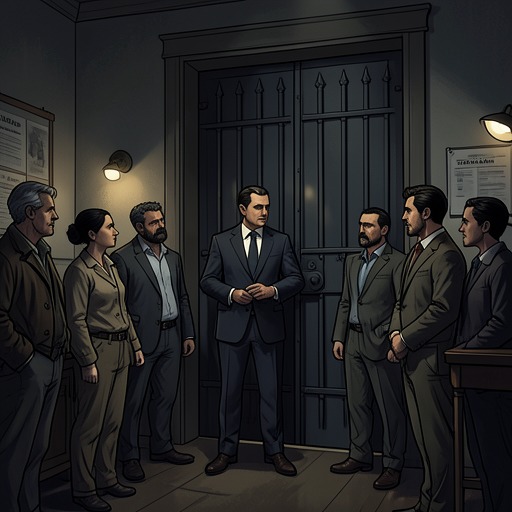
The arrangement struck Inspector Montalbano as surprising: Cardamone was to work under official sanction with the man who had been his rival’s closest political right hand. Montalbano’s initial surprise gave way to a more practical reading. The party had an established inclination toward compromise, and Cardamone might not yet have enough influence to govern alone. Rizzo’s presence could give him support, even as it carried Luparello’s political inheritance into the new administration.
Nicolò Zito, an influential opposition editorialist, offered a more critical interpretation. In his account, Luparello and Cardamone were two faces of the same coin, with Rizzo as the alloy joining them. A later conversation supplied details that made Rizzo’s position look less like a routine accommodation. Zito said that the secretariat was composed almost entirely of Luparello’s men, apart from two Cardamone representatives who were there, in his view, to create an appearance of democracy. The expected successor, he suggested, should therefore have been one of Luparello’s followers. Instead, Rizzo stood up and proposed Cardamone. The other members were speechless but did not dare object; Zito inferred that they feared some danger beneath the move and chose to follow Rizzo’s lead. Cardamone then accepted and proposed that Rizzo serve beside him, to the dismay of his own two representatives. Zito understood Cardamone’s decision as an attempt to keep Rizzo close rather than leave him beyond control. These are Zito’s explanations of the maneuver, not a settled account of what the participants privately intended.
Exclusion and the Limits of Renewal
Luparello’s widow connected the political reshuffle to the circumstances in which her husband had been found. She reasoned that his clothing had been put on in haste after he was surprised naked at the little house at Capo Massaria. In her view, the staging was intended to damage his public image and make him vulnerable to pressure. She added that the plan had succeeded in part: all of her husband’s men had been excluded from the new leadership, while Rizzo alone escaped exclusion and had, in fact, gained from the outcome. Her account makes the succession look like a struggle over the political uses of scandal as well as over party office, but it does not establish who engineered the broader realignment.
The result is deliberately less clear than a simple transfer from one secretary to another. Cardamone held the formal office and represented a different stated policy toward the left; Rizzo, whose power had been associated with Luparello, secured a sanctioned place beside him. Luparello’s old followers were largely pushed aside, yet the presence of his political heir meant that the new leadership could not be read as an uncomplicated repudiation of his influence. The succession thus exposes the gap between public claims of renewal and the informal alliances through which authority is negotiated: a party can change its secretary quickly while leaving the decisive question of who commands its loyalties unresolved.